Blood cancer is actually a term applied to three different types of cancer – leukemia, lymphoma and myeloma. For centuries, these cancers had virtually no possibility of survival. Even as recently as the 1960s, the five-year survival rate for leukemia was 14%. By 2010, it had increased to 61%. Similar gains have been made in the survival rates for lymphoma and myeloma, with Hodgkin lymphoma reaching a five-year survival rate of 88% in that year. The story of the science behind the gains in survival rates and the development of ever-more effective therapies is the story of advances in the field of immunotherapy and personalized medicine taking place at centers such as Abramson at UPENN and Dana-Farber in Boston.
Bone Marrow Transplants
The first significant increases in survival rates occurred in the early 1980s, with the introduction of chemotherapy and bone marrow transplants. In a UPENN CureTalks interview in 2017, Dr. Carl June of UPENN described the two-step process. First, the patient’s immune system received super-lethal doses of chemotherapy. Then, bone marrow from a sibling was transplanted into the patient. When the result was a better survival rate, the increase in survival was attributed to the super-lethal dose of chemotherapy administered prior to the transplant. When the procedure was performed on identical twins and researchers discovered that increased survival did not occur, researchers had to rethink their premise. They realized that the source of the survival increase lay in the differences in the marrow of the non-identical sibling rather than in the process of destroying the patient’s immune system before the introduction of new bone marrow.
This better understanding of the cause of increased survival rates from bone marrow transplant therapy, combined with the significant downside arising from graft vs host disease, led June to explore the possibility that patients could receive the benefits of a bone marrow transplant without an actual transplant. He studied the possibility that a patient’s own immune system could be used as a weapon. The outcome of this work was the development of CAR-T cells, approved for use by the FDA in 2017.
CAR-T
CAR-T therapy is the first personalized cancer therapy to be approved by the FDA. The process has been licensed by Novartis. They have manufactured CAR-T cells for patients in their FDA-approved facility. With CAR-T, a patient’s own T-cells are filtered, along with white blood cells, through the leukapheresis process. A viral vector is used to recognize the targeted cells – cells with cancer and other cells expressing a specified antigen. These “reprogrammed” cells are then introduced back into the patient’s blood.
According to June, it is not at all uncommon for a high fever to occur during the time when the CAR-T cells are annihilating the cancer cells. This fever has shown no lasting effect. It is a side effect that indicates that the process is working. For two of the first three participants in the clinical trials held at Penn in 2010, the survival rate for chronic lymphocytic leukemia (CLL) was eight years as of 2018.
Immune Checkpoint Inhibitors
Another FDA-approved immunotherapy agent is used in patients with recurring Hodgkin lymphoma (HL). The FDA approval occurred in 2016, but a study underway in 2019 at Dana-Farber by Dr. Margaret Shipp’s team is investigating the mechanism that causes two proteins, PD-L1 and PD-L2, to overproduce on HL cells. They’ve found that the proteins work with a protein on the T-cells that keeps the T-cells from attacking the HL. By blocking PD-1, it is possible to expose the HL to the T-cells. The use of these checkpoint inhibitors holds promise for those with HL that has reoccurred or not responded to the first therapy.
BiTE
Until recently, a patient’s immune system was reprogrammed to fight a single target – an antigen. Dr. Daniel D’Angelo of Dana-Farber describes BiTEs (bispecific antibodies) as a way to cut out the middle step. Rather than attack first one, and then the other, the BiTE attaches to both a T-cell and a tumor cell at the same time. This FDA-approved therapy is being used to treat acute lymphoblastic leukemia (ALL) but shows potential for the treatment of other cancers.
The potential advantage of BiTEs over CAR-T cell therapy lies in the fact that BiTEs are not patient-specific: There is not the need to remove and reprogram T-cells for reintroduction into the patient’s blood. Currently, BiTE is being used with patients who have multiple myeloma (MM) and have relapsed. Early results are promising. In one clinical trial, some patients showed no trace at all of cancer after treatment. The next step is to see how long this remains the case, as well as whether or not different delivery times or the use of BiTE in conjunction with CAR-T will make a difference in the outcome.
Under Study
At the ASH Annual meeting held at Abramson Cancer Center, two new studies were described.
One study is designed to determine the best time to introduce CAR-T therapy in multiple myeloma (MM). It will identify T-cell biomarkers that help to predict the outcome from CART-BCMA therapy (Abstract #1974 and Abstract #1886). The other explores the combination of CAR-T cells and the tyrosine kinase inhibitor ibrutinib in chronic lymphocytic leukemia (CLL). Initial results show that the use of both in combination will lead to deep and sustained remission (Abstract #298).
The current work is already leading to new avenues of investigation. Improved blood cancer therapies are one part of the advances being made in targeted, personalized therapies.
Published on BioSpace
Since the inception of competition, gaining a competitive advantage has been a persistent goal for athletes. For centuries, the competitive advantage naturally went to those with faster reflexes, greater stamina, and body types that “fit” the sport. In the 1900s, weight training entered sports in earnest when it was demonstrated that physical training brought an advantage beyond natural ability. The role of diet was also considered, with athletes debating whether or not “carbing-up” before a game made a difference. As athletes pushed their bodies to do more, pain killers came into use during games to allow athletes to continue playing after being injured. With painkillers came the question of whether or not “playing hurt” might shorten a player’s career. Overall, the performance an athlete might achieve was set by what was innately possible for that individual.
Steroids entered the sporting scene in the 1980s and literally changed what it meant to be competitive. Natural talent, training and exercise, or the use of painkillers no longer constituted the greatest tools available. Now athletes could not only bulk up to unimagined levels, but they could also recover from injuries in record time. These banned substances conferred a competitive advantage beyond what was possible through grit and hard work alone.
Beyond Natural Ability and Limits
The latest innovation in the push to ever-better results in sports is the use of bioengineering. This blending of biology and engineering to improve an athlete’s abilities can be put to use through a variety of methods that range from the unintrusive to the truly intrusive.
At the unintrusive end of the spectrum, one might study a pitcher’s motion to detect moments that cause fatigue leading to possible injury. Understanding the biomechanics of the pitching motion makes it possible to alter the motion. Another approach might be to use the biological properties of materials along with engineering to design swimsuits or uniforms that render the swimmer more aerodynamically efficient or keep athletes more comfortable during play. Both of these practices take current personal medicine and equipment manufacture to new levels, yet neither makes a permanent change to the athlete’s biology.
In the 21st century, with the mapping of the human genome, we have the ability to shift the paradigm entirely through the use of direct genetic modification to enhance a player’s abilities at the cellular level. For example, could — and should — technologies such as CRISPR be used to alter athletes’ DNA? What would be the repercussions of reducing muscle fatigue or improving vision far beyond normal human capabilities using such techniques? And, despite earnest discussions around the ethics of genetically modifying babies, there are likely to be some parents interested in modifying their children before birth to give them athletic advantages. Indeed, companies already promising training plans, injury prevention tips, and nutrition guidance based on DNA — the first step toward muddy waters.

Eventually, we might see the manufacture of “kits” that would alter an individual’s DNA in the specific ways necessary to bring about the best performance in a given sport. Controversial figures such as Josiah Zayner are already selling gene editing kits out of garages; with improved technologies, one can’t help but wonder whether such kits could be easily accessible by athletes and their coaches to perform back alley gene editing where once the crime in the shadows was administration of performance-enhancing drugs.
The results could be like nothing we have ever seen — and could create an entirely new category of athlete. Forget working out and eating carbs; these new athletes would have the edge before they ever broke a sweat or ate a bowl of pasta.
But such a future is incredibly controversial. Beyond the next level of steroids, bioengineering the next generation of athletes carries with it ethical considerations at the core of being human. “Designer babies,” such as those whose genomes have been edited for genius-level intelligence or soccer-star abilities, have long been a concern for gene-editing advocates and opponents alike.
Debating the Role of Bioengineering in Sports
In 2018, the Global Sport Summit held a panel addressing the implications of gene editing in sports. The panel focused on CRISPR because it is a technology that makes it possible to alter an individual’s DNA without detection using current technology. The positive possibilities of CRISPR could include a method for curing rare diseases. Yet, using CRISPR to alter an athlete’s DNA — also known as sports doping — is already included in the World Anti-Doping Agency’s (WADA) banned technology because of its potential to confer limitless competitive advantages at the genetic level. The panel’s consensus was that we are on the brink of a formerly unthinkable level of control over our genetic makeup.

This possibility brings with it new areas of concern and debate. What will constitute unethical enhancements? Will it be as clear as stating that anything that brings an athlete’s vision to 20/20 is acceptable while anything that takes it beyond that level is not? Will enhancements that allow a player to watch a fastball coming toward them, as Mickey Mantle once said, appearing like a moon hanging in the air along the way, be considered ethical because they do not break new ground? Who will define the line between peak performance and unfair advantage?
There is already a divide between athletes who train with the latest and best equipment and techniques and those who do not. If some athletes are recipients of bioengineering and others are not, will those without it ever be able to complete? Will we be creating a category of athletes that have superior ability that precludes others entering into play?
Bioengineering and Society
By opening the conversation around CRISPR as a technology for improvements in sports performance that is likely the first of many more to come, we are able to view the ramifications of its use from a distance. We can speak about tennis players or golfers, baseball players or swimmers, and debate the pros and cons of making these alterations and their effect on the game. The bioengineering debate in sports focuses on specific changes that might enhance performance in a specific set of circumstances.
Once bioengineering at the level of DNA becomes common practice in medicine, it will be only a matter of time before it becomes part of what athletes do to prepare for participation in competitive sports. With genetic engineering accepted in medicine and sports, it will open the door to questions of use in the general population. The difference is that the pros and cons of altering DNA for the performance of daily tasks will not be as clear as the alterations needed to cure a lethal disease or to enhance a particular aspect of sports performance. Enhancing success in everyday life won’t be about hurling a fastball or racing around a track; it will be about less tangible attributes such as the ability to remember all the details of a case or transaction without notes or the ability to work for 72 hours straight without needing sleep.
As was the case with workouts, cross-training, painkillers during a big game, and the use of steroids, the use of genetic modification in sports will usher in the possible use of genetic modification in the general public. As coaches, athletes, scientists, and fans approach the unknown potential of genetic modification in sports and beyond, we are wise to be wary. We know what has happened as a result of even the smallest attempts to influence the sporting outcome through artificial means — even with relatively “benign” approaches. With that information in hand, we need to be cautious when we consider using genetic modification on something as essential as our own DNA. We must be certain that we proceed with care, with controls in place that make it possible to know what has been modified and what has not until we can observe the effect of these changes over time. We must also take whatever experience has to offer and keep it at the front of the debate about the effect of these new technologies on society as a whole, as well as upon each individual.
Published on SynbioBeta
Cows have had a bad rep over the past few years, due to the amount of methane they release — which some say contributes to the global issue of rising greenhouse gas emissions: the heat-trapping potency of methane is almost thirty times higher than that of CO2. Additionally, clearing forests and other land to provide space for cows intended for human consumption releases significant amounts of carbon dioxide into the atmosphere. Many recommend drastically reducing or even completely eliminating beef and dairy product consumption, but it is unlikely that everyone on earth will become vegetarian. What if there were another solution? What if methane could be transformed from a waste product to a useful product, such as a food source — bringing a whole new meaning to using every “part” of the animal?
A vision of a world in which methane is turned into food for human consumption would be reminiscent of the alchemist’s unsuccessful quest to turn lesser elements into gold but for one essential difference: one company is actually succeeding. String Bio — based out of Bengaluru, India — is making protein from methane.
“It is dangerous to release methane gas into the environment because methane is a much more potent greenhouse gas compared to CO2 … what occurs today is that methane gas gets burnt off, called flaring, converting it to CO2, and consequently is released into the environment. So our thinking is why not leverage the carbon to make useful products instead of burning it off?” said String Bio CEO Ezhil Subbian in a 2018 interview with the SolarImpulse Foundation.
Truly sustainable protein
According to Subbian, String’s driving force is to find “solutions that are pertinent to fundamental problems in Asian geography that can then be taken out to global markets.” India is the perfect place to meet their goals, with a considerable amount of resources being dedicated to synthetic biology approaches to improve agriculture. At the 2017 Hello Tomorrow Global Summit in Paris, Subbian introduced the company’s first product — a high quality, cost-effective protein designed to address the growing gap between supply and demand in terms of sustainable food. The process uses methane on the STRING Integrated Methane Platform (SIMP) — a fermentation-based platform designed to create monomers for use in new products, such as their alternative protein.
String Bio’s protein is only used in animal feed today, but further refinement to make the protein suitable for human consumption is ongoing. Subbian describes the taste of String’s protein as similar to whey. When it is purified to a point that it is ready for human consumption, they plan to sell it to another company that creates meat alternatives (such as steak or fish) that can be prepared on the grill like real meat. “When it gets there, we’ll need to bring a good chef on board,” jokes Subbian. String plans to have a commercially viable protein product this year.
Subbian’s idea resonates with investors worldwide. At the HT Global Summit, where Subbian presented String Bio’s protein, the company was awarded one of ten HT Global Summit competition awards, which include non-equity cash and the opportunity to pitch to international deeptech investors for Seed and Series A funding. Subbian’s passionate focus on her company’s protein has also earned String Bio funding from the Future Food Asia Award in 2017, as well as a SBIRI grant from BIRAC and the EnABLE startup award in Industrial Biotechnology sector in 2016, and the first of the Karnataka government grants for innovative ideas in 2013.
Making a bold idea that anyone can buy into
While the idea to take a greenhouse gas and convert it to a usable feed stuff has investors sold, companies like String Bio face an important regulatory — and social — hurdle. In 2017, at the FLEDGE Synthetic Biology Policy & Implementation Issues Seminar, Subbian identified one of the chief challenges facing companies developing solutions through synthetic biology as apprehension relating to the ability to define “a new living organism developed through synthetic biology.”
This apprehension, as well as widespread concerns about the organisms themselves, has slowed work with living organisms in the field in the past. One concern has been that an organism developed for one use might have unintended, unanticipated effects on other organisms in an interaction. Another concern is that what is thought to be a complete understanding of a gene may prove to be an incomplete understanding, with unwelcome results.
Government agencies and the general public have also had experience with species that were brought into an area to solve one problem only to cause a different, more serious problem. This is not the case when the organism is used in a process like fermentation, but the need for sustainable solutions to a host of global and environmental problems is likely to lead to solutions for living organisms in the future.
The team at String has dealt with uncertainty about the future regulatory environment and public acceptance proactively. It has government backing — which in India, typically comes with public acceptance of a new technology — and its location in Bengaluru isn’t by accident either, as the city is located in a State that is generally welcome to synthetic biology and biotech innovation. String Bio has also worked to achieve active affirmation from global investors. All of this work has paid off — not only has the company developed a proven technology, but they also hold the patent for their SIMP platform.
String describes itself as a company that believes in “bold bets.” To focus on one source — methane –for all of its products might seem such a bold bet. Yet Subbian believes she is setting up her company to meet its goal of providing cleaner ways of living through “robust, cradle-to-cradle solutions.” Now that’s a bet that even the cows can get behind.
Published on SynbioBeta
Source: Pivot Bio.
Pivot Bio is disrupting the N fertilizer industry with the release of PROVEN™, their sustainable nitrogen-producing microbe for corn. In trials last year, farmers using this flagship product had a 7.7 bushel per acre advantage over chemical fertilizers in all sorts of weather in 13 different states and 47 different soil types. Karsten Temme, CEO and co-founder of Pivot Bio, said in a press release: “The $212 billion fertilizer industry has essentially remained unchanged for 100 years, until now. For the first time, there’s a better alternative.”
Farmers that participated in the trial cited several benefits in addition to increased crop production. They saved money by applying the microbe one time with existing equipment. They worried less because they knew their corn crop was being fertilized consistently by microbes that increased in number and daily nitrogen dose as the root system grew. Using PROVEN™ saved them time; it wasn’t necessary to test the soil, reapply the fertilizer, or take steps to keep the fertilizer from contaminating nearby water sources or polluting the air.
The environmental benefit from this sustainable product is considerable. Nearly 5% of the greenhouse gases emitted annually are from agriculture in the form of nitrous oxide that originates primarily from fertilizer, Pivo Bio’s Industry and Regulatory Affairs Manager, Keira Havens, explained in her 2018 Breakthrough Dialogue Tech Talk. This is not the case with PROVEN™. The environmentally friendly microbe is applied in the furrow and attaches to the root. As a result, volatilization does not take place.
PROVEN™ is already sold-out for 2019, and Pivot Bio estimates that when use of their product reaches thirty-five percent of the U.S. corn market, additional environmental gains will be achieved. Nearly 20,000 metric tons of nitrous oxide emissions – the equivalent of emissions from nearly 1.5 million cars – could be reduced or prevented. In concert with this, up to 500,000 metric tons of nitrates could be prevented from leaching into groundwater.

The key to the results achieved by PROVEN™ lies in the fact that Pivot Bio has taken a new approach to the development of this product, Havens said. Rather than work with an “either/or” mindset where something can either be economically efficient or environmentally beneficial, they moved into a “both/and” mindset. This allowed them to envision products that are both efficient and effective at preserving the environment. They then rethought the process of catalyzing nitrogen and explored ways to move away from the Haber Bosch method of synthetic nitrogen production.
The Haber Bosch production method is currently the leading method. It catalyzes the nitrogen from the air into a form that can be applied to the roots of corn and utilized by the plant. When it was introduced at the start of the 20th Century, it led to significant gains in crop production. As the need for ever-greater crop yields continues, Haber Bosch is nearing the point of unsustainability. To produce existing production quantities, 2% of total world energy consumption is required. The resulting chemical fertilizer has an environmentally unfriendly 50% waste due to runoff, leaching, and volatilization.
The desire to move in a “both/also” direction led Pivot Bio’s scientists to a solution utilizing microbes. “Through nearly a decade of research, we understand how microbes work in nature before they adapted to heavy fertilizer use. We take that knowledge and enable these naturally-occurring microbes to work as nature intended again,” said Alvin Tasmir, Pivot Bio Chief Science Officer and Co-Founder. By mapping the soil microbiome and studying the characteristics, Pivot Bio scientists identified microbes with inherent genetic potential for atmospheric nitrogen fixation. When they found microbes that could achieve this while maintaining crop health, they then worked with those microbes to enhance the ability to release nitrogen to the roots. This approach not only resulted in a one-time application, it achieved an adequate supply of nitrogen for the growing plant without harmful environmental effects.
“We are committed to rapidly bringing innovation to the world that supports farmers’ desire to use more sustainable products while continuing to improve their bottom line,” says Temme. In keeping with this desire to meet the needs of the future without compromising the needs of future generations, several new products are in the pipeline. “These include next generation nitrogen-producing microbes for corn and products for wheat, soybeans, sorghum and rice,” Havens says. “The company will expand beyond the U.S. into other parts of the world including Europe, Asia and Latin America.”
Published on SynbioBeta
Runners in cities in the U.S. and India will join together in the Racefor7 event on February 24. This annual 7K is held to raise awareness and empower patients with rare diseases in their quest for effective treatment options. “We will form a human chain between the U.S. and India, with nearly 15,000 people walking 7K at the same time,” says local socialpreneur, Dr. Harsha Rajasimha.
Rajasimha co-founded race-organizer ORDI (Organization for Rare Diseases India) to bring together scientists, policymakers, patients, and those in the pharmaceutical industry to connect across borders. The goal is to increase the number of clinical trials for rare diseases worldwide by adding the population of India to the candidate pool. The nonprofit will act as a catalyst to accelerate clinical research and bring about more timely diagnosis and treatment in India, where millions of people live with one of the more than 7,000 currently identified rare diseases.
Marshall Summar, MD, Director of the Rare Disease Institute, Children’s National Medical Center and Chairman of the Board at the National Organization for Rare Disorders (NORD), will be kick off the race in DC. “I’m really excited to wave the flag to start this year’s Racefor7,” says Summar of his role at the epicenter of the regulatory environment for drug development and clinical trials in the U.S. “What a great event and what a way to bring the rare disease communities of the U.S. and India together.”
Rare diseases strike a small percentage of the population. This results in a disincentive to research and develop a treatment for these conditions. Not only is there difficulty in gathering a large enough group for a clinical trial, but the market is often not big enough for drug makers to recoup the cost of developing the new drugs. With these two factors impeding much needed new medicines, it’s clear that something like the U.S. Orphan Drug Act of 1983 was necessary if these rare illnesses were ever to get the attention they merit.
Progress has been made in the United States because the Orphan Drug Act assures seven years of market exclusivity for pharmaceutical companies that develop a treatment. Yet, the average age at diagnosis of these conditions is 7 years for children and families who have lived with a frightening unknown during that time. Even with the passage of this act and the progress that has been made, there is no approved treatment for 95% of rare diseases. There is much left to be done and, since the majority of these conditions are genetic in nature, our growing knowledge of the human genome makes this the time.
Uniting the United States and India in efforts to find treatments for rare diseases is advantageous to both countries, says Rajasimha. With a population equal to the combined populations of the United States and Europe, India has a far larger number of children affected by rare diseases. India also has some long-standing genetic lines that can be investigated. By adding the estimated 70 million people in India affected by rare diseases to the estimated 30 million people in the United States, research can be carried out on a larger scale than would be possible using the population in the United States alone. This additional research can lead to treatments more quickly.
For India, the ability to introduce diagnostic tests and procedures like those used in the U.S. will make it possible for an exponentially greater number of infants and children with rare diseases to be diagnosed early on when interventions might make a difference. It will also benefit those in India who participate in clinical trials because the treatments that are discovered will be available to them.
For Rajasimha, holding the Racefor7 to bring greater awareness and action to the rare disease field and include the larger population of India in the pool of candidates for rare disease trials to dramatically expand the potential pool of patients for these trials is just the first step. There must also be a way to conduct clinical trials at a fraction of the current cost. His goal is to hold remote clinical trials in which patients using available FDA-approved technology like the Apple Watch will be able to have their health information tracked by doctors performing clinical trials that include patients around the world.
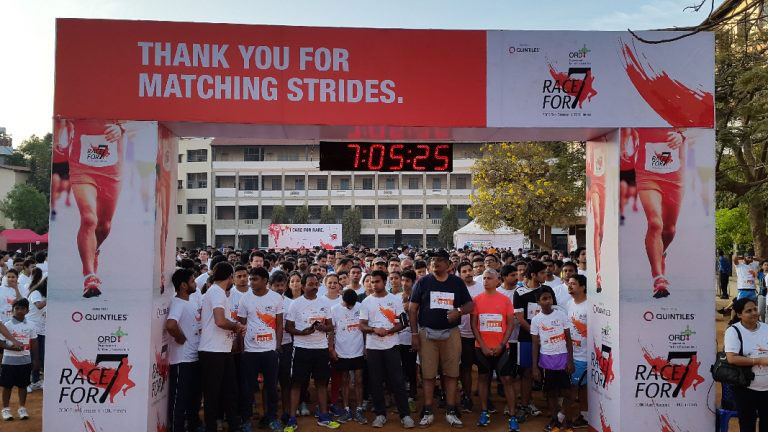
For Rajasimha, holding the Racefor7 to bring greater awareness and action to the rare disease field and include the larger population of India in the pool of candidates for rare disease trials to dramatically expand the potential pool of patients for these trials is just the first step. There must also be a way to conduct clinical trials at a fraction of the current cost. His goal is to hold remote clinical trials in which patients using available FDA-approved technology like the Apple Watch will be able to have their health information tracked by doctors performing clinical trials that include patients around the world.
To make this vision a reality, Rajasimha is putting his passion for this cause together with his professional experience and expertise. His firm, Jeeva Informatics, is working to avoid costly clinical trials by making remote collaboration possible. On the heels of a successful internship program last Fall that helped build the prototype, Rajasimha is currently raising a seed round of investment capital. If all goes as planned, the first proof-of-concept tests will take place this summer.
Published on BioBuzz
When construction is completed this month, 704 QO will offer ready-to-occupy lab/office spaces for companies of all sizes. What really makes this new building stand out isn’t just the fully customizable individual lab units, but the suite of amenities that are tailored to the specific needs of emerging life science companies in the BioHealth Capital Region and the employees that work for them.
Developed by South Duvall, a subsidiary of Scheer Partners, this building showcases a sophisticated knowledge and understanding of the life science market and companies in their emerging, as well as established, stages. South Duvall hopes to achieve full occupancy in the next few months. We met with Aaron Gambini, Vice President of Scheer Partners, Inc. to learn the inside scoop on this property.
Here are FIVE things that make 704 QO stand out:
1 The concept for 704 QO is simple. “We want this space to be a rallying point for the life sciences community,” says Gambini. To achieve this, South Duvall has created lab space with amenities that are employee-friendly and aid in the retention of hard-to-find talent in this competitive biotech market. They’ve housed all of these amenities in a building that is designed to meet the private needs of biomedical companies while encouraging tenant interactions and a sense of community. The result is a very attractive work environment that helps companies recruit and retain the best employees.
2 This building was selected because it was one of the last existing office buildings within the immediate Gaithersburg Life Science Cluster that had not been converted to lab space. The area was in desperate need of readily-available lab space. By building several labs on spec, South Duvall had labs immediately available for occupancy for the first several tenants, with additional space in the works.
3 Lab-friendly amenities include an autoclave, glass wash station, sink, and ice maker for use by all of the tenants. They even have an onsite self-service supply store managed by VWR. It will stock lab supplies and disposables such as gloves, goggles, and pipettes to make sure tenants have everything they need at their fingertips. Tenants will use a card to swipe their way into the store, then pay for their purchases via a phone app.

4 Tenant-friendly amenities include an industrial refrigerator filled with yogurts, waters, and other treats for the tenants’ employees. The coffee/tea station has baskets of chips and fresh fruit. A cold-brew coffee station – chosen by current tenants after a taste testing event – is also located in this kitchen area. Vintage Pacman machines and a shuffleboard table stand ready for some action. There is also a small lounge for those who need a bit of space, as well as a fitness center with showers. All of these are free for the tenants’ employees and guests.
5 Various meeting spaces is available for use by tenants and other industry organizations seeking a place to meet. This positions 704 QO as a community hub to host programs, meetings, and other events of interest on a regular basis. These private rooms have ample seating with tables that can be arranged in a variety of configurations. There is a large screen with a connection to a laptop for presentations. In this new building, South Duval has filled a void for life science-oriented community space that is needed in the county.
Other plans for 704 QO include new signage and a patio area with benches and tables to be installed along the front of the building. Another exit from 270 (now under construction at West Watkins Mill) will ease commuting woes. And, a concierge will be on hand to facilitate reservations for the meeting rooms, as well as for other events.
Matt Brady, Sr Vice President at Scheer Partners, shared some insight that supports this real estate development philosophy in a recent LinkedIn article titled, ‘Facilities as a Recruiting Tool for Talent in the Next Generation Lab Market.’“To ensure Maryland life science companies can recruit and retain the best and brightest employees, there will be an emphasis on their facilities as a draw and differentiator,” shared Brady. “High finish levels, in-building comforts and entertainment to offer employees, access to exterior amenities and transit, prestigious address, etc. will all come into play in this next generation of the market.”
The vision for 704 QO goes beyond a community hub, a tenant-friendly, or an employee-friendly building. With amenities selected to aid in the retention of hard-to-find talent, space that makes it feasible for smaller organizations to have their own facility, and a schedule of speakers and activities that will be attractive to those in the life sciences sector, 704 QO is designed to engage the professional community while serving as a model for other life science buildings in the BioHealth Capital Region.

Published on BioBuzz